 Sign In
Affect vs. Effect: How to Remember the Difference and Use Each Correctly
Updated May 2026.
The difference between affect and effect matters more than most writers realize. The two words sound nearly the same. They look almost the same on the page. But picking the wrong one can confuse your reader. The good news is that the rule is simple. This guide explains the difference, the grammar behind it, and the easy memory trick that solves most cases.
Quick Answer: Affect vs. Effect
Affect.
Usually a verb. It means "to have an impact on something." Example: "The weather affected her mood."
Effect.
Usually a noun. It means "a result or outcome." Example: "The weather had a strong effect on her mood."
The memory trick.
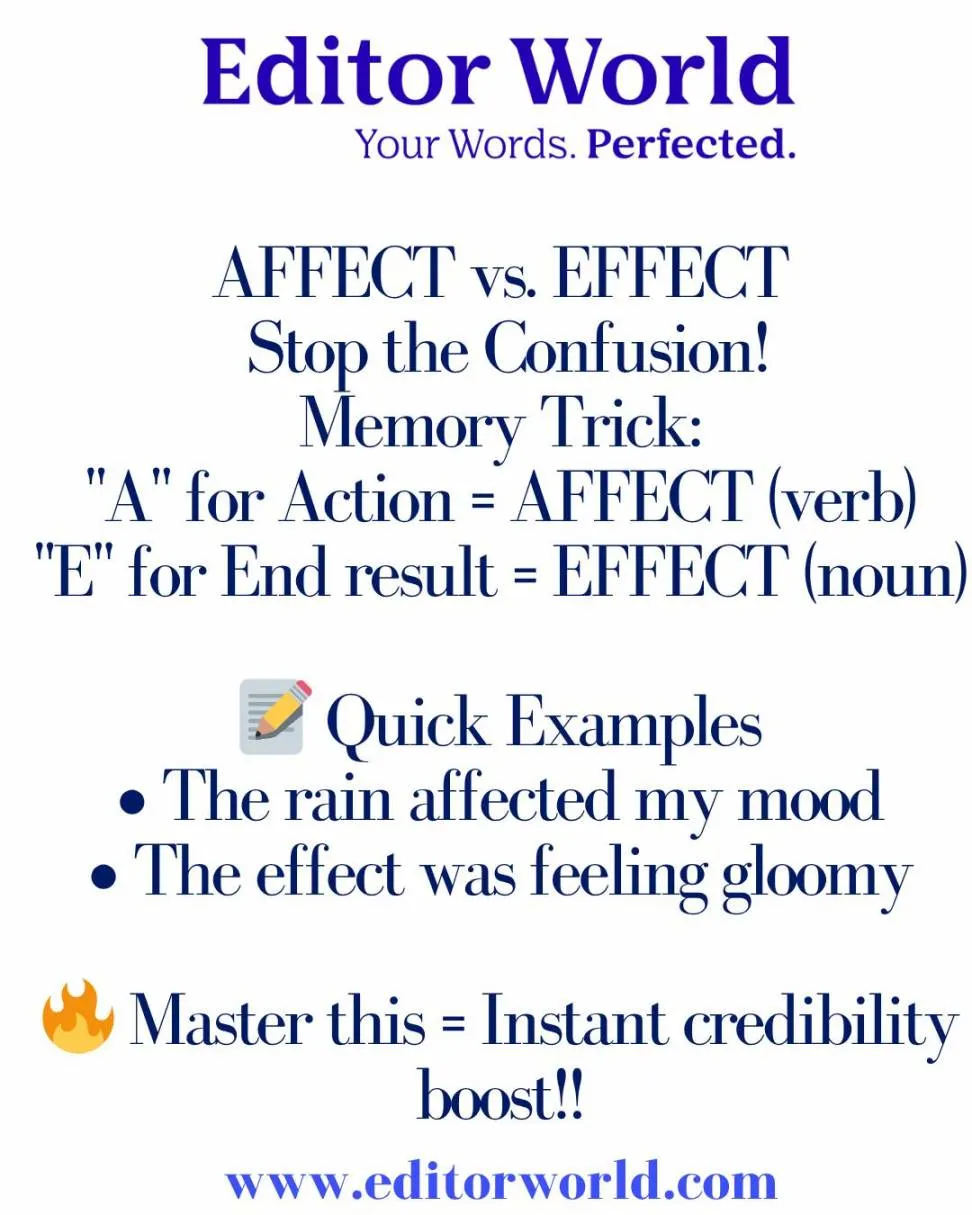
Affect is the Action. Effect is the End result. The "A" in affect stands for action (verb). The "E" in effect stands for end result (noun).
Affect and Effect Are Homophones
Affect and effect are homophones. Homophones are words that sound the same but have different meanings or spellings. English has many homophone pairs that trip up writers, like "their," "there," and "they're," or "your" and "you're." Affect and effect are one of the most confused pairs in academic and business writing.
The trick to using each one correctly is to know which part of speech you need. The next two sections break it down.
When to Use Affect
Affect is almost always a verb. It means "to have an impact on" or "to cause a change in." If you can swap in the word "impact" or "influence" and the sentence still makes sense, affect is the right choice.
- The bad weather affected her commute.
- The new policy will affect every employee in the building.
- Lack of sleep can affect your emotional state and your focus.
- The findings affected the team's research direction.
- Loud noises can affect a child's concentration during testing.
In each example, affect is the verb. Something does something to something else. The action causes a change.
Affect as a Noun: The Less Common Use
Affect can also work as a noun, but only in a specific context. In psychology and clinical writing, "affect" refers to a person's outward emotional state. It describes how someone shows their feelings through facial expression, tone of voice, and body language. This use is rare outside of clinical settings.
- The patient presented with a flat affect.
- Her affect seemed appropriate to the situation.
- The therapist noted a marked change in his affect.
In these examples, affect is a noun. It refers to a visible emotional state. This is not the same as feelings or mood. Affect is the outward sign of an inner emotional state. If you're writing outside of clinical psychology, you'll almost never use affect as a noun.
When to Use Effect
Effect is almost always a noun. It means "a result" or "an outcome." If you can swap in the word "result" and the sentence still makes sense, effect is the right choice.
- The new policy had a strong effect on employee morale.
- The medication's side effects were mild.
- Climate change is having a clear effect on coastal cities.
- The film's special effects were stunning.
- The teacher's praise had a positive effect on the student's emotional state.
In each example, effect is a noun. It's the result, the outcome, the consequence of something that happened.
Effect as a Verb: The Less Common Use
Effect can also work as a verb. As a verb, it means "to bring about" or "to cause." This use is less common and shows up most often in formal writing.
- The new manager hopes to effect real change in the department.
- The committee's goal is to effect a smooth transition.
- The reforms were designed to effect a fairer system.
Notice the meaning. "Effect change" means to cause change to happen. "Affect change" would not make sense. This is a common error in business and policy writing. The verb form of effect is fairly rare in everyday writing, but it's a real and useful word.
Affect vs. Effect: Examples Side by Side
Seeing the two words in matched pairs makes the rule clear.
| Sentence | Correct Word | Why |
|---|---|---|
| The storm ___ our weekend plans. | affected | Verb. The storm did something to the plans. |
| The storm had a big ___ on our weekend. | effect | Noun. The result of the storm. |
| Stress can ___ your sleep. | affect | Verb. Stress acts on sleep. |
| One side ___ of the medicine is drowsiness. | effect | Noun. The result of the medicine. |
| The CEO wants to ___ real change. | effect | Verb form of effect. Means "to cause." |
| The therapist noted a flat ___. | affect | Noun form of affect. Refers to emotional state. |
How to Remember the Difference Between Affect and Effect
The easiest way to remember the difference between affect and effect is the A and E trick.
- Affect = Action (verb). The action affects something.
- Effect = End result (noun). The end result is the effect.
A second trick uses the word "impact." Most of the time, you can swap "impact" in for either word and see how it works.
- If "impact" works as a verb in your sentence, use affect. Example: "The news will impact her" becomes "The news will affect her."
- If "impact" works as a noun, use effect. Example: "The news had a big impact" becomes "The news had a big effect."
If you remember the difference between affect as a verb and effect as a noun, you'll get the right word in nine out of ten cases. The other one in ten is the less common forms covered above.
Common Phrases with Affect and Effect
Some set phrases use one word or the other in ways that don't follow the simple rule. These are worth knowing.
- Side effect. Always effect. The result of a medicine, action, or process.
- Special effects. Always effect. The visual or sound effects in a film.
- Personal effects. Always effect. A person's belongings or possessions.
- In effect. Always effect. Means "currently in force" or "essentially."
- Take effect. Always effect. Means "to begin operating."
- Cause and effect. Always effect. The relationship between an action and its result.
- Effect change. Always effect. The verb form, meaning "to cause change."
- Flat affect. Always affect. The clinical psychology term for a reduced emotional state.
Common Mistakes to Avoid
- Using "effect" as a verb when you mean "affect." "The weather effected my mood" is wrong. Use affected. The weather is acting on the mood.
- Using "affect" as a noun when you mean "effect." "The medicine had a strong affect" is wrong. Use effect. The medicine produced a result.
- Confusing "effect change" with "affect change." "Effect change" is correct when you mean "to bring about change." "Affect change" is wrong because affect is rarely a transitive verb in this construction.
- Using "affect" instead of "effect" in set phrases. Personal effects, side effects, special effects, in effect, and take effect always use effect, not affect.
- Relying on autocorrect. Many word processors won't flag affect/effect errors because both words are spelled correctly. The error is in word choice, not spelling.
Frequently Asked Questions
What's the difference between affect and effect?
Affect is almost always a verb. It means "to have an impact on." Effect is almost always a noun. It means "a result." Example: The storm affected our plans (verb). The storm had a big effect on our plans (noun). The easy memory trick: A for action, E for end result.
Is affect ever used as a noun?
Yes, but rarely. In psychology and clinical writing, "affect" can be a noun that refers to a person's outward emotional state. It describes how someone shows feelings through facial expression and tone. Outside of clinical writing, you'll almost never use affect as a noun. In everyday writing, treat it as a verb.
Is effect ever used as a verb?
Yes. As a verb, effect means "to bring about" or "to cause." Example: "The new manager wants to effect real change." This use is less common and shows up most often in formal writing about policy or business reform. The verb form of effect is correct but easy to miss because the noun form is so dominant.
Is it "effect change" or "affect change"?
It's "effect change." This is one of the most common errors in business writing. "Effect change" uses effect as a verb, meaning "to cause change to happen." "Affect change" would mean "to act on change," which doesn't usually make sense in context. When you mean "to bring about change," use effect.
How do you remember the difference between affect and effect?
The simplest trick is the A and E rule. Affect starts with A, which stands for action (verb). Effect starts with E, which stands for end result (noun). A second trick: swap in the word "impact" and see how it works. If it works as a verb, use affect. If it works as a noun, use effect. These two tricks solve most cases.
Is it "side effect" or "side affect"?
It's "side effect." Always. A side effect is a result of a medicine, action, or process. It's a noun. Side effect, special effects, personal effects, in effect, and take effect all use effect. Never affect in these set phrases.
Are affect and effect homophones?
Yes. Affect and effect are homophones, which means they sound nearly the same but have different meanings and spellings. The slight difference in pronunciation (a soft "a" in affect, a soft "e" in effect) is hard to hear in casual speech. That's why so many writers confuse them in writing.
Interested in learning more commonly confused words? See our article on the differences between advice and advise.
Get Expert Help with Editing and Proofreading
Mastering commonly confused words like affect and effect is one part of producing polished writing. Editor World can help you take your written documents to the next level. Use our Instant Price Calculator to see how much your edit will cost. Then choose a professional editor from our roster.
Every editor is a native English speaker from the United States, United Kingdom, or Canada. Every editor has an advanced degree in their field. Every document is reviewed by a real person, never by AI. A free sample edit of up to 300 words is available on request.
This article was reviewed by the Editor World team. Editor World, founded in 2010 by Patti Fisher, PhD, provides professional editing and proofreading services for students, academics, authors, and businesses worldwide. BBB A+ accredited since 2010 with 5.0/5 Google Reviews and 5.0/5 Facebook Reviews.